When it comes to image manipulation and generation through AI platforms, there’s a lot of potential for misuse and exploitation. More specifically, taking advantage of AI deep fake tools could have extreme effects on political or social experiences if one is malpracticing. These tools could be used by those in power to influence or manipulate droves of people, but also in more local situations, where any person could use image manipulation to try and gain power over another individual.
When AI gets attention for recovering lost works of art, it makes the technology sound a lot less scary than when it garners headlines for creating deep fakes that falsify politicians’ speech
Sonja Drimmer, How AI is Hijacking Art History, The Conversation
The amount of fake information that is on the web is ever increasing, and when a large amount of national/international news is found online targeting audiences that may be easily impressionable with fake images or news is dangerous. People are able to employ AI deep fakes to portray presidents, politicians, and celebrities in ways that could be detrimental to their image. Moreover, people could use image generation to portray fake story lines across time. One could recreate, or manipulate old photographs to conform old narratives to a certain agenda. We experimented with one form of this by colorizing photos from Carleton’s digital archive, then adding them to Carleton’s Omeka collections.
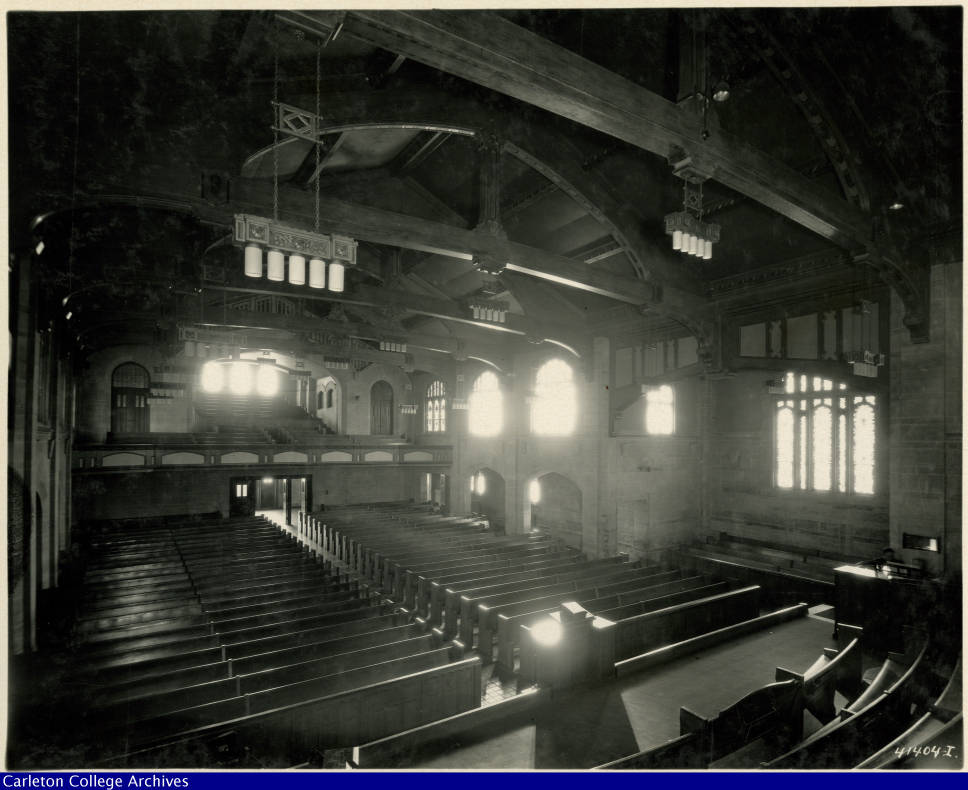
“Interior of the chapel from the choir loft”
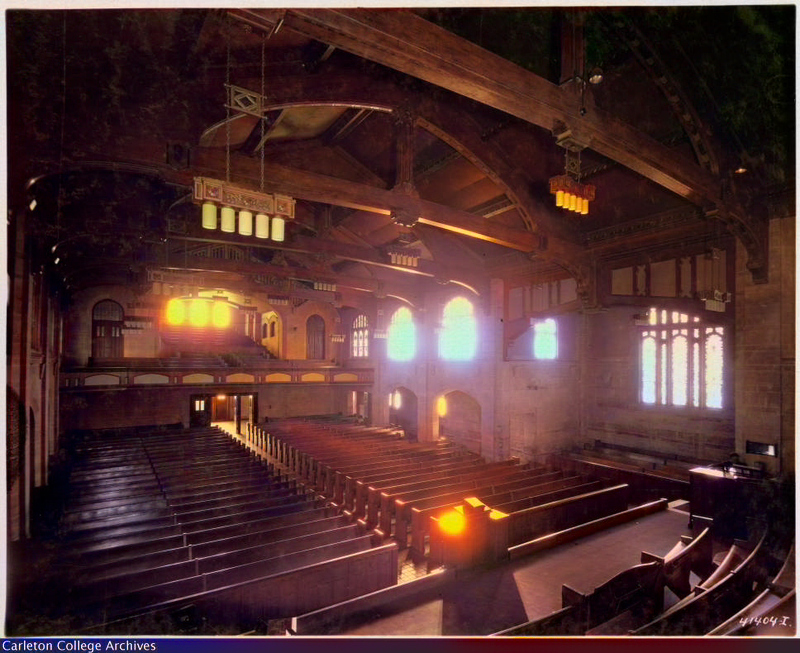
This effort to “bring events back to life” routinely mistakes representations for reality. Adding color does not show things as they were but recreates what is already a recreation
Sonja Drimmer, How AI is Hijacking Art History, The Conversation
Although I was pretty intrigued, and amazed by the fairly accurate recoloring of the chapel’s interior, certain aspects of the image left me feeling a little skeptical about using a tool like this in the future. For one, there are two different lightings that have been recreated, immediately making me question which is the truest portrayal (or if neither are). Additionally, I’m curious about where the AI gets a basis for the decisions it makes when it comes to the colors that they’re using. I felt that the pews and walls are pretty similarly colored to the chapel we see now at Carleton, does the AI reference recent images on the web and choose colors from that? What are the real methods it’s using?

In my assignment, I similarly focused on potential political exploitation. It is fascinating that you point out the possibility of targeting specific audiences that are especially susceptible to fake images or news. I think there has been a generational divide in that sense. Our generation has become better at questioning the validity of certain photos or news and practicing skepticism when deciding to trust a source purely because we have grown up at the onset of artificial intelligence development. I think older generations who have not had the same experience with this new technology may have a harder time distinguishing the real from the fake.
I found your discussion over “deep fakes” and the political/social implications of AI modified and generated images and videos very interesting. I also found that DeOldify was not very transparent of their methodology (specifically in the updated version), and it would have been interesting to learn whether or not they used images of the chapel that are on the web currently to help inform making decisions. I found both your skepticism and your eagerness to learn more very motivating for myself, as I think I have remained perhaps too cynical over AI usages, and I could shift that to curiosity.
I found your discussion over “deep fakes” and the political/social implications of AI modified and generated images and videos very interesting. I also found that DeOldify was not very transparent of their methodology (specifically in the updated version), and it would have been interesting to learn whether or not they used images of the chapel that are on the web currently to help inform making decisions. I found both your skepticism and your eagerness to learn more very motivating for myself, as I think I have remained perhaps too cynical over AI usages, and I could shift that to curiosity.
It is interesting to see the perspectives on how AI can also have negative political impacts. This is a new era of AI, as the technology is rapidly developing, but many people are still unfamiliar with it and can be misled by AI-generated content. I think newspapers and other official political sources should avoid using AI-generated images, while less political platforms should at least provide some warnings.