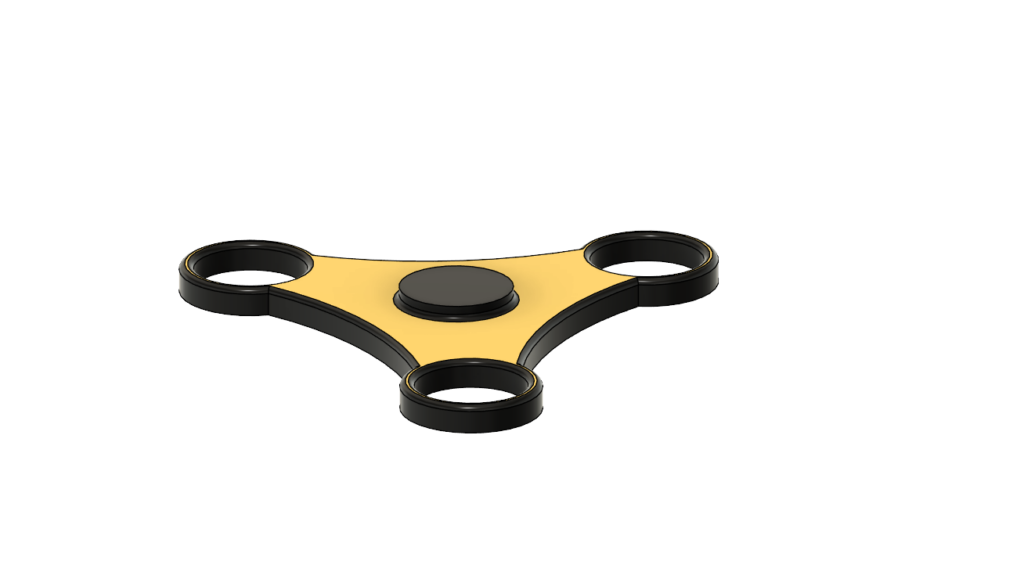


<Fidget Spinner Interactive Viewer>
The object I modeled is a fidget spinner, a toy I often played with in middle school. Since this was my first time using Fusion 360, the initial learning curve felt steep. I had to spend time simply understanding where tools were located and how they worked. The software offers a wide range of features, which made it difficult at first to know what was possible within my limited knowledge. To start, I chose a design that was static, regular, and symmetrical—a fidget spinner. I began with a 2D sketch using line and circle tools to map out the design. Since precision was important for this object, the ability to specify exact lengths and degrees was especially useful, which I highly recommend to utilize for novice users. Converting the sketch into a 3D model with the extrude tool was more challenging, but still manageable once I understood the process.

Difficulties arose when I experimented with less structured objects. For example, I tried to model a doughnut with icing and sprinkles. While the base doughnut and sprinkles were easy straightforward, the icing layer was much harder. Because the extrude tool only adds depth in one direction, it couldn’t capture the wavy, fluid surface I wanted. Through tutorials, I learned that an emboss tool could create such effects. This showed the steep learning curve of Fusion 360: the basics ones are fairly intuitive, but more advanced features require practice. I also had to simplify my models until I gained more technical skill.
<Initial Doughnut Interactive Viewer>
Beyond Fusion 360, 3d modeling has broad potential for research and education. For instance, it could be used to digitally reconstruct historical artifacts or architecture, making them accessible for both scholarship and public engagement. One unique advantage is the ability to ‘look inside’ objects—examining their inner structure beneath the surface, which would be impossible with photographs or physical replicas. This makes it valuable for us to explore abstract concepts, hidden mechanisms, or even physically impossible shapes. By creating accurate and interactive models, we can bring ideas to life in ways that static images cannot.

I like the fidget spinner. I find an object like this to be very interesting to model. It isn’t symmetrical in the same way a rectangle is, but it still is symmetrical. As you mentioned angles, I think of the underlying triangle beneath. Really gets you thinking about the geometry. I find the experiment of modelling the donut to be more interesting. In a perfect world, the donut would be a perfectly round torus. The frosting would distribute 100% evenly, but that isn’t the case. Using only primitive shapes, it can’t be done without looking “wrong.” I’d assume something seemingly so simple could only be done by experts or people that are well practiced. Maybe if a 3D donut needs to be modelled for a scene at a coffee shop, it not being the focus could mean that it doesn’t need to look that realistic or convincing. Context matters a lot. If the donut is the focal point of the scene, it would need to look a lot more natural.