I chose an old picture of the interior of the Chapel from the Carleton website. Since this picture was taken 20 years ago, it is only in black and white. Hence, I use AI to color this picture to make it have its original colors. Then I post on the website:https://dgah.sites.carleton.edu/digtialobjects/admin/items/show/208. (I cannot log in Omeka website through my own username, so I borrowed Harrah’s to create a new item)

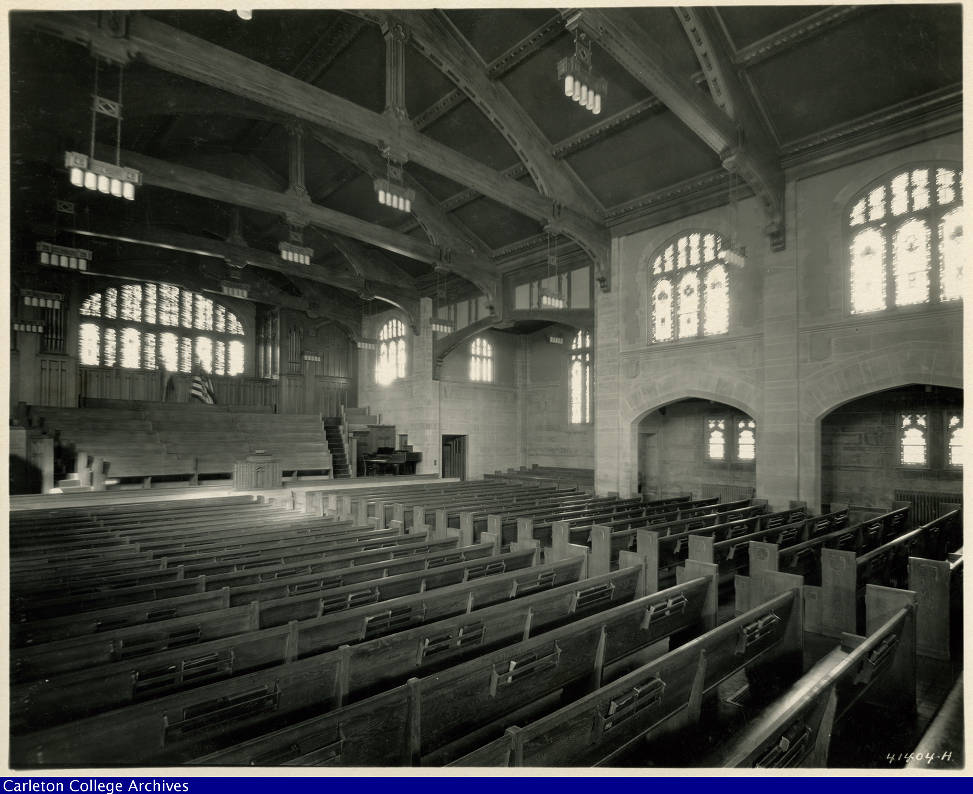
Although this picture overall recovers the color of the old picture, and is similar to the realistic color, it still has many detailed mistakes. For instance, the floor color is totally different from what the chapel looks like today, and the texture of the building is also different.
I believe the most fundamental ethical issue lies in AI image processing’s compromise of historical authenticity and the marginalization of the humanities. AI colorization algorithms is based on nowadays database to reflect contemporary aesthetics and computational logic in their color choices rather than historical reality. More significantly, such technologies are reshaping the public’s understanding of “knowledge production,” granting computer science undue authority while diminishing the expertise of traditional humanities disciplines.
As Sonja Drimmer saying in “How AI is Hijacking Art History”: “These studies and projects also seem to promote the idea that computer scientists are more adept at historical research than art historians.” But this idea is totally wrong and also dangerous. Computers can never replace humans, since humans have their own thinking of histories and also the feeling of history created by them. AI can just be used as a tool for people to efficiently memorize history.
Also, Ted Chiang pointed out that “ChatGPT can be understood as a blurry JPEG of all the text on the web.” AI can just provide an unclear frame for people and cannot offer all correct details for people. It is just a way to arouse people’s memories.
All in all, when we completely hand over the processing of historical images to algorithms, we lose the opportunity for direct dialogue with the original materials.

Tags: Colorized image, AI, Digital Humanities

I also colorized an old image of the chapel’s interior. It’s pretty interesting to see the different recreations of the image, especially when it comes to the color. The color of the rafters and pew decorations in my colorized images were a lot more rustic and muted compared to your AI manipulation. I wonder if the light exposure might’ve been a reason the AI generated such different scenes. It also furthers my curiosity about whether AI references some sort Carleton chapel (or other random chapel?) photos that are on the web, and basis its recreation off of that. Also, if it were to find an reference old Carleton chapel photos, how did those photos differ in terms of age?