Many of my teammates lived in the downstairs of Scott House last year. I choose to 3D model this building purely because of my familiarity with it. What I didn’t account for were the trees obscuring large portions of the structure, the steep height on the back, and the limited accessibility of each side. These factors made it very challenging to make an accurate 3D model, or really just any type of 3D model at all. Additionally, I experienced difficulties with aligning all of my pictures. I took a total of 74 pictures and was only able to align a maximum of 52 images.
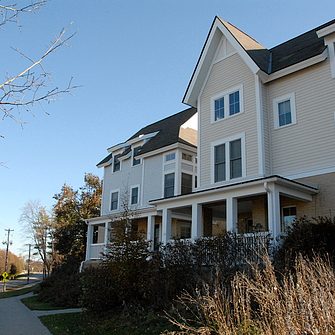
The process of photogrammetry requires a great deal of attention to detail. I believe most of this lies in the process of capturing the raw photographs. Steady and overlapping images are crucial to the output of the model. A small flaw in a photograph creates a jumble in the finished design. This is definitely where I went wrong. If I were to do this again, I would take additional time to ensure each photo was taken with enough overlapping imagery. Accuracy of the final product depends on the software, but a software can only output something as strong as the inputs it receives. In that light, photogrammetry feels as much like careful fieldwork as it does 3D modeling.
Previously walking by or entering Scott House, I was a passive observer. Becoming an active modeler creates an entirely new perspective. Choosing how to capture Scott House shapes the version of the townhouse others will see. This made me more aware of the role of the author in digital reconstruction. The overall process revealed that 3D modeling, when done correctly, can communicate history or lived experience in a way that day-to-day observation or photographs cannot.
My (failed) embedded MetashapePro 3D model can be viewed below.

I had a similar experience with 3D modeling to you. I appreciate how you wrote about the technical challenges that you faced such as your photo alignment and the limited accessibility you faced when taking pictures. I also liked how you wrote about how your experience transformed from passive observation to active interpretation of Scott House. Even though the model didn’t turn out perfectly, it sounds like you gained some good skills and awareness about how digital reconstructions shape understanding.
Similar to you and Gabriel, I also had a rough experience with 3D modeling. I definitely agree with your point about steady overlapping photos. I know I was not nearly close enough to having enough overlapping photos which is definitely the main reason mine is messed up. I also agree that even though this didn’t turn out perfect, you (and I) both learned a lot.