From reading everyone’s blog posts thus far, it seems as though we are all in the same (sinking) boat for this lab assignment. I’m not proud of the model or the scan of Dow that I made (both embedded below), but after much troubleshooting, I don’t see a clear way to make them much better. The Polycam scanner did not work with the 30 images I took, so I used the AI generated feature to fill in the gaps. The result is better, but not as accurate because it had to guess what the back of the house looks like.
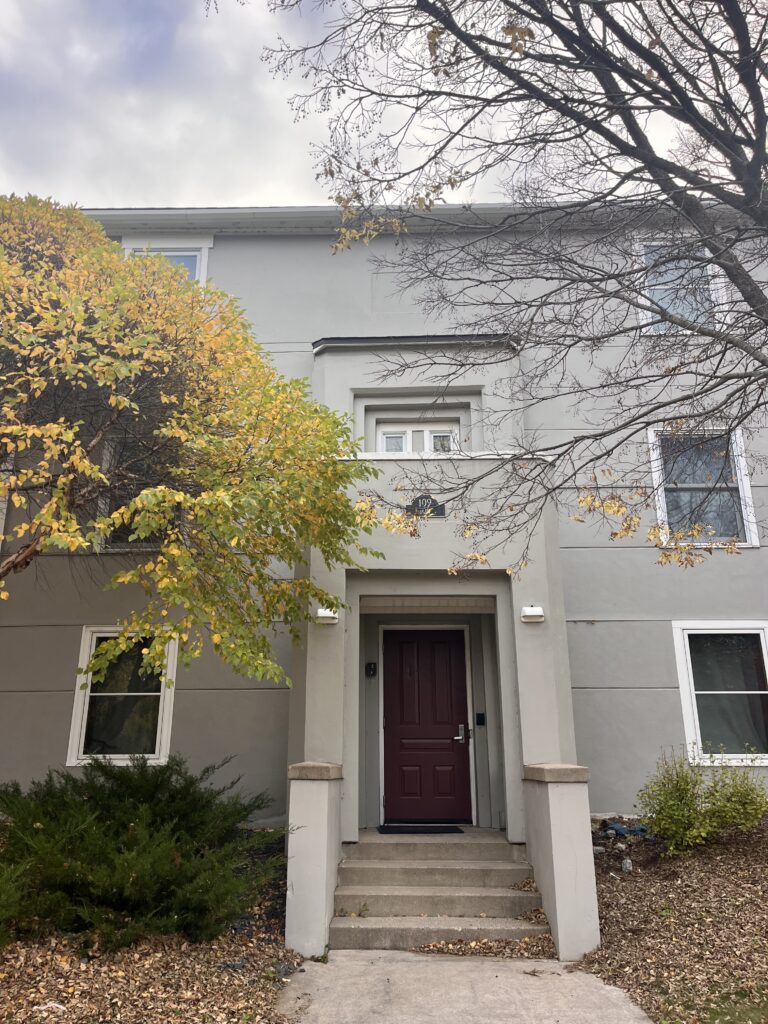
For reference, here is what Dow House (or at least the front of it) is supposed to look like. Lower Dow (entrance on Divison Street) is quad style living with two doubles. Upper Dow, with the entrance across from the multicultural center, has two stories and houses 6 people (2 doubles and 2 singles). Since it is townhouse living, residents are allowed to be off the meal plan, have their own laundry facilities, and have easy access to Downtown Northfield, according to the description on the Carleton website.
As you can see, my Metashape model is not very accurate. Regardless of how frustrating the process was, I still see value in modeling versus photographing. Reflecting on the process, I think Photogrammetry/3D modeling definitely encourages closer attention to detail than just taking images of the object. I think one reason for this is because to create an accurate model, you need many overlapping photographs from multiple perspectives. The photos also need to be taken in consistent lighting and focus, which I think was one of the main issues with my model. This inherently makes you notice small details, especially on such a large object like a house that I never would have thought to look at. For example, I started to notice the wear and tear on the building when I looked at it in the model, but I don’t usually notice that when I walk by the house in person. This also goes hand-in-hand with comparing modeling and viewing. I think modeling a building is an active process that made me engaged with the content and the spatial layout of the building. When you view a photo or a map, you are just passively observing what is presented to you – maybe the layout, the exterior, the general historical style, etc. But when you are actively engaged in making a model, you are required to think more spatially or structurally. I noticed more about the angles, the layout, the proportions, and the texture of the building when I was making the model compared to when I was just photographing Dow. I think there is value and applicable uses for understanding an object’s place in space.

Hi Megan! First, I want to say that although your photogrammetry may not be particularly three dimensional, I think that you captured a great amount of detail in Dow House’s front. As you say, photographs only allow for passive viewing of structures, which directly opposes the freedom that three dimensional representations allocate to users. You show that off perfectly in your model, and I think the results were photogrammetry phine.
I really like your post! I faced the same problems as you when modeling the house. Although we may have failed to create an accurate 3D model, we still learned many things in the process. I think one reason for it, besides what you mention, may also be the trees or other objects around the house. Also, I totally agree that we can see the object from more aspects.
My model also has issues with 3d-modeling, and it looks a bit off on one side of the house. However, I think it is what we have to deal with sometimes in these projects. I like your introduction on the Dow house, and it certainly matters to have this information along with the 3D model. I think it is very true, like you said, that we only notice the details of a house when we have to build it virtually, and I’m surprised by how many details of these Townhouses I’m missing by just walking past them every day!
I completely agree that photogrammetry can be both challenging and rewarding! I also found it difficult to capture a full 360° reconstruction of my 3D building. Your use of AI-generated features makes a lot of sense, especially since filling in missing areas can be tough (I faced that issue too). I didn’t use AI assistance this time, but after seeing your results, I’m curious to try it and reflect on how it changes the reconstruction process.
Megan, first of all I think your title is hilarious. But also, I heavily resonated with what seemed to be a very difficult experience for you. I also had a really hard time getting the software to cooperate and produce a legitimate and real looking model. My final product was unimpressive but it certainly does not reflect the effort I put into the process-and neither does yours. Good job and way to finish strong.